Dinesh D'Souza
Conservative Filmmaker and Author
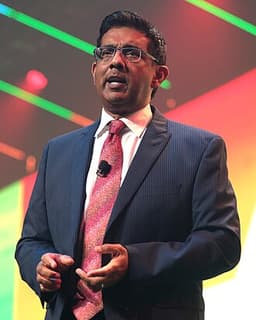
Dinesh D'Souza is a conservative author, filmmaker, and political commentator who has produced a series of political documentaries and books targeting Democratic political figures and institutions. He is associated with the American Enterprise Institute and other conservative organizations, and his films — including "2016: Obama's America" — have attracted large audiences in conservative circles. He pled guilty in 2014 to a federal felony charge of making illegal campaign contributions through straw donors and was sentenced to probation and community service. President Trump pardoned him in 2018, which D'Souza and his supporters characterized as acknowledgment that the prosecution was politically motivated.
D'Souza's 2022 documentary "2000 Mules" claimed to provide definitive proof of widespread ballot harvesting fraud in the 2020 presidential election, relying primarily on cellphone geolocation data. The film was widely viewed in conservative circles and generated significant revenue. Election experts, the Associated Press, and independent fact-checkers analyzed the methodology and concluded that it could not support the conclusions the film drew — cellphone location data at that resolution could not distinguish between illegal ballot harvesters and postal workers, residents, or passersby. D'Souza continued promoting the film after these analyses were published.
In May 2024, Salem Media Group — the distributor of the film — publicly retracted "2000 Mules" and issued an apology, acknowledging that the film's claims were not supported by reliable evidence. The retraction was part of a settlement in a defamation lawsuit brought by individuals depicted in the film. D'Souza disputed the circumstances of the retraction and continued to assert that the film's core claims were accurate.
D'Souza remains an active presence in conservative media. His supporters view his work as important political counter-programming; critics argue that his films and commentary have consistently spread claims that courts, election officials, and fact-checkers have found to be unsupported.